
Review · SWEDEN
Abisko: Ice Fishing Experience
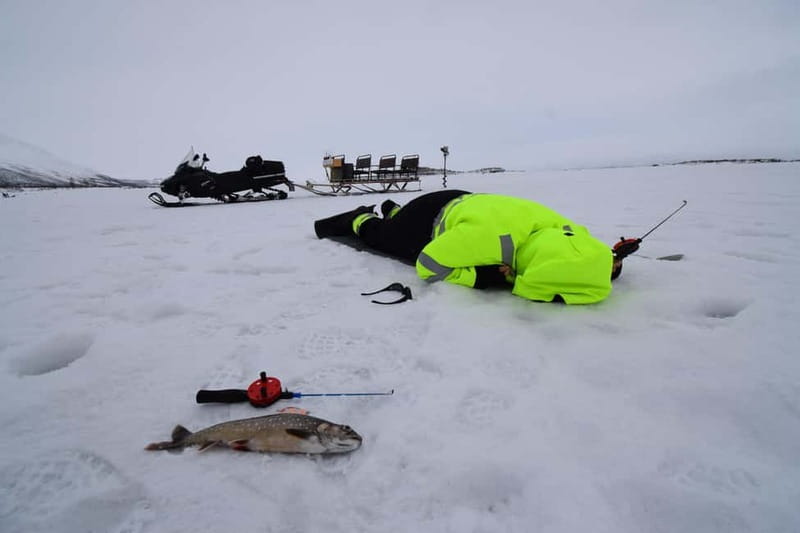
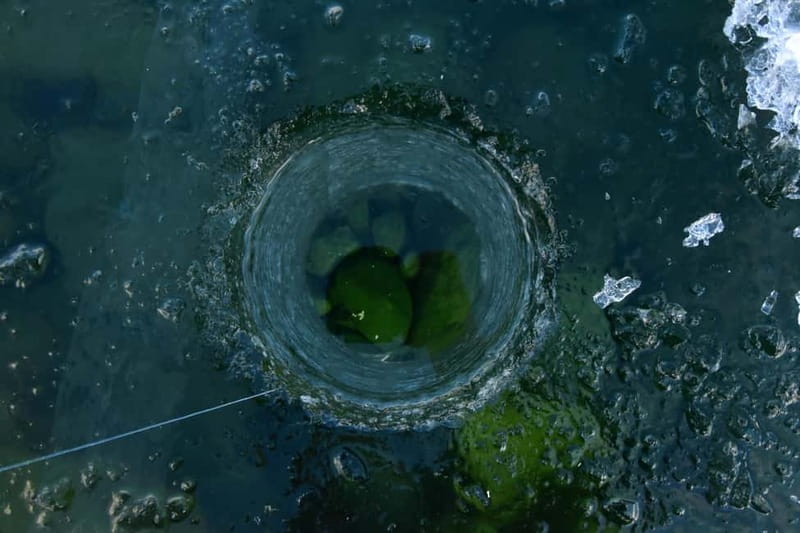
Standing on a frozen lake in Swedish Lapland is the main event here. Your guide takes you by car or snowmobile to a suitable lake, cuts holes through the ice, and shows you how to lower a line into the dark water below. At some lakes, the water is so clear that you can watch fish move toward the bait.
I like the hands-on format. You do not simply watch a guide fish. You learn to drill your own hole and use the equipment yourself. I also like the chance to see Arctic char, grayling, or burbot at close range, even if the fish do not bite. The main drawback is simple: two hours can pass quickly, and a catch is never guaranteed. Bring patience, warm socks, and realistic expectations.
Key points to know before you go
- You fish on a real frozen lake: Early-season trips often use smaller lakes near Abisko, while later outings commonly head to Torne Träsk.
- You get involved from the start: The guide teaches you how to drill through the ice and handle the fishing gear.
- Clear water can make the wait exciting: You may see fish approach the hook below you.
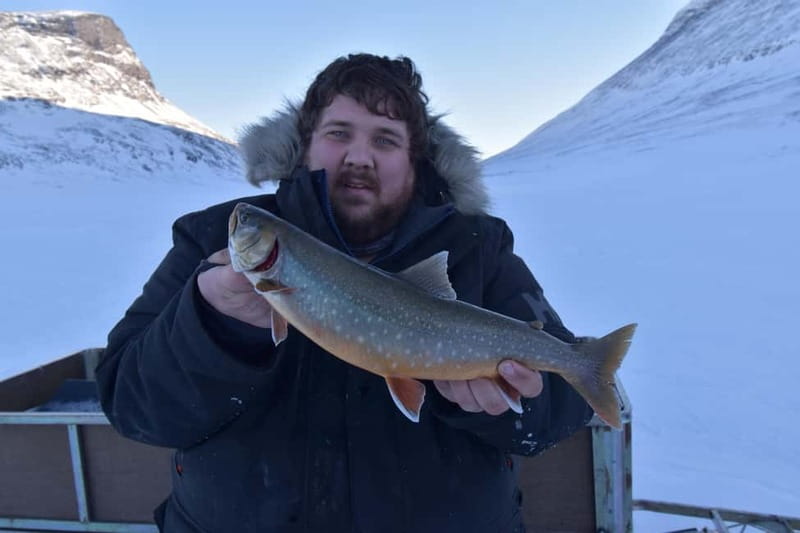
- The common catches are Arctic char, grayling, and burbot: Whitefish, trout, and perch are also possible in some lakes.
- Most practical items are included: Transport, bait, equipment, warm clothing, drinks, and a light snack come with the $99 price.
- The fishing license costs extra: Buy the Kiruna Municipality license online or at Godisfabriken Supermarket in Abisko before setting out.
What the two-hour Abisko ice fishing trip is really like
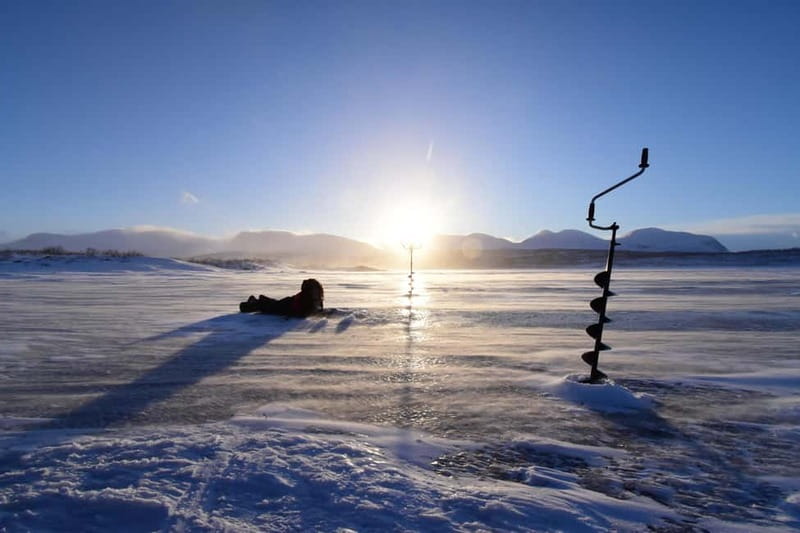
Ice fishing has a slower rhythm than many northern activities. You are not racing from one sight to another. You make a hole, set your line, and wait. That quiet wait is part of the appeal, especially when you are standing in a place where solid ice replaces the usual lake surface.
The experience begins at one of four pickup points: STF Abisko Turiststation, Abisko Guesthouse, Abisko Mountain Lodge, or Experience Abisko. Pickup at the guesthouse and Experience Abisko is listed as the main start point. If you are staying at STF or Abisko Mountain Lodge, plan to be ready 10 to 15 minutes before the trip begins.
From there, transport takes you to a lake selected for the season and current conditions. The trip may use a car or a snowmobile. That detail matters because it keeps you from having to arrange your own transport or carry fishing equipment through the snow.
The exact lake is not fixed. Early in the season, the smaller lakes around Abisko are commonly used. Later, the outing often heads to Torne Träsk, the large lake north of Abisko. This seasonal change gives the trip a sense of place. You are not fishing in an artificial setup designed for tourists. You are going to the water conditions that make sense at that point in winter.
More Ice Fishing Trips in the world:
- Rovaniemi: Snowmobile and Ice Fishing Adventure with Lunch
★ 4.8 · 879 reviews - Fairbanks Ice Fishing Expedition in a Heated Cabin with Fish Cookout
★ 5.0 · 461 reviews - Rovaniemi: Ice Fishing Experience
★ 4.5 · 379 reviews
Drilling through the ice is part of the fun
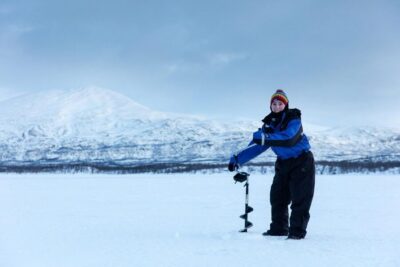
Once you reach the lake, the guide explains how ice fishing works and shows you the equipment. The first practical task is drilling a hole through the ice. You are allowed to take part, which makes this more than a scenic stop beside a frozen lake.
The drilling also gives you a quick lesson in the thickness and strength of the ice. You need to pay attention to the guide and follow instructions carefully. The supplied information does not give a minimum ice thickness or detailed safety rules, so the guide’s directions matter throughout the activity.
After the hole is ready, you learn how to use the rod, line, lure, and bait. You do not need previous fishing experience. Equipment and bait are supplied, and the English-speaking guide explains the process from the beginning.
That makes this a good choice if you have never fished before. You can focus on learning rather than worrying about whether you brought the right rod or know how to set up a line. Experienced anglers may find the instruction basic, but the setting and clear water can still make the outing worthwhile.
Clear water gives you something to watch
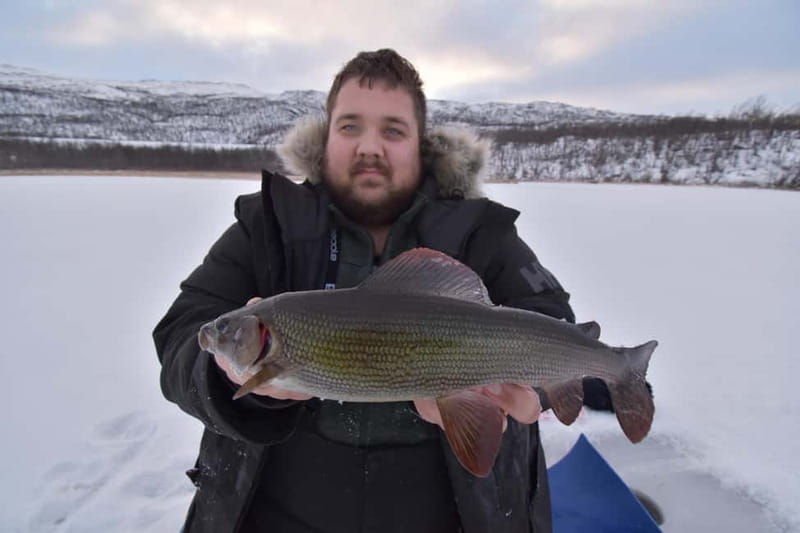
The best feature of this trip is the possibility of seeing fish approach below the ice. In many of the lakes around Abisko, the water is clear enough for you to look down the hole and watch a fish come toward the bait.
That changes the usual fishing experience. Normally, you stare at a float or feel for movement through the line. Here, you may see the fish before it bites. The sight of a fish circling the bait can be exciting even when it turns away.
One January outing showed how useful that clear water can be. The group did not catch a fish, but they could see several fish swimming around the hook. That is a helpful point to keep in mind: a successful trip is not defined only by what ends up in your hands.
Still, it is worth being honest about the fishing. Fish may approach and then leave. A line may go taut, only for the fish to escape before you bring it up. You need to enjoy the process, not book this as a guaranteed meal.
Which fish might you catch near Abisko?
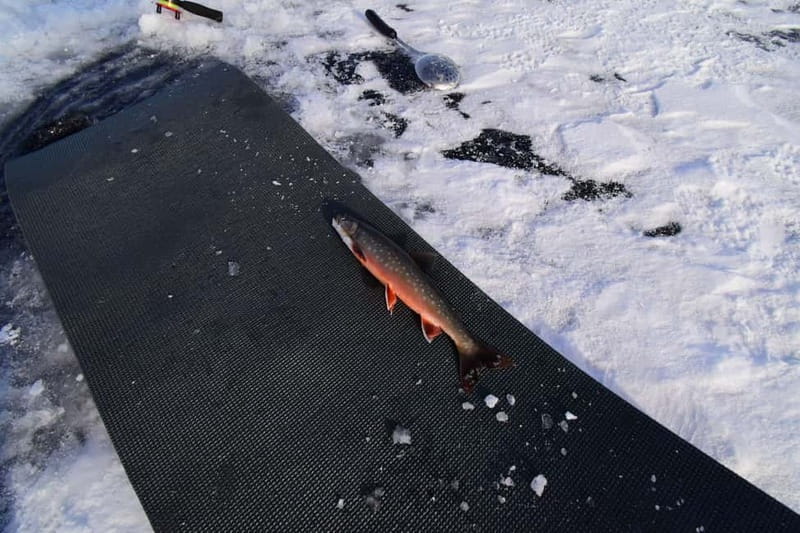
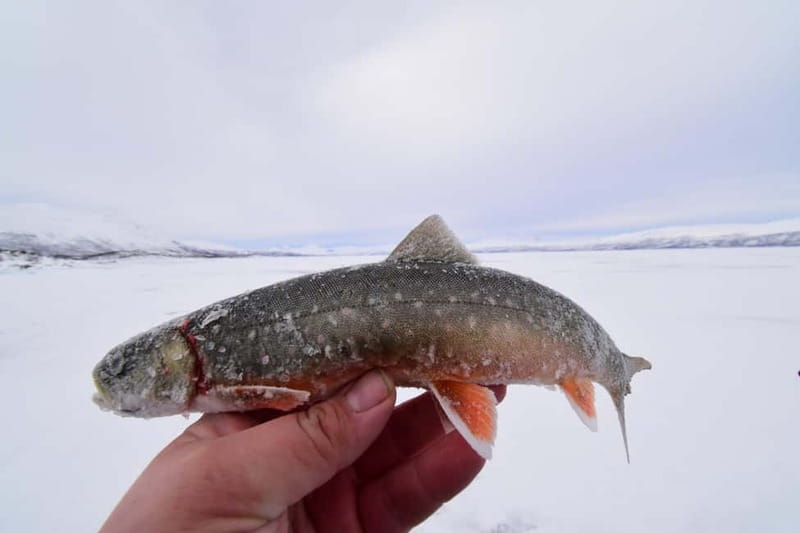
The most common catches are Arctic char, grayling, and burbot. These are well suited to the cold northern waters and give the outing a strong local character.
You may also catch whitefish or trout. Perch are possible in a few lakes, but they are not listed as a catch in every location. The exact species depends on the lake used that day.
If you catch a fish above the minimum legal size for its species, you may keep it for food. The guide can help clean the fish and offer advice on cooking it. All the fish listed for the Abisko area are described as suitable for eating.
You should still treat keeping a fish as a possibility, not the purpose of the booking. The two-hour time limit gives you enough time to learn the basics and fish for a while, but not a long window for repeated attempts. If you are lucky, you may return with dinner. If not, you still get an unusual view of the life beneath a frozen lake.
More fishing trips around the world:
- Tromsø: Arctic Fjord Cruise & Fishing Experience
★ 4.7 · 4,588 reviews - Cooking Class Hoi An:Local Market, Basket Boat, Fishing & Cooking
★ 5.0 · 3,660 reviews - Hoi An Cooking Class(Market,BasketBoat Crabfishing&Cooking Class)
★ 5.0 · 3,386 reviews - Hoi An Cooking Class(Local market,Basket Boat,Fishing & Cooking)
★ 5.0 · 1,323 reviews
What is included for $99?
The price is $99 per person. That is not the cheapest way to spend two hours in Abisko, but the value improves when you consider what is included.
You receive:
- Transportation to and from the fishing area
- An English-speaking guide
- Fishing equipment
- Bait
- Warm clothing
- Warm drinks
- A light snack
The supplied warm clothing is useful, but it does not replace your own base layers. Thermal underwear and warm socks are not included. You need to bring those yourself, along with other warm clothing.
I see the price as reasonable for a short guided outdoor activity in a remote northern setting. You are paying for transport, gear, instruction, and access to a lake you may not be able to reach easily on your own. The value is strongest if you are new to ice fishing and would otherwise need to rent equipment, find transport, learn the rules, and buy bait separately.
The value is weaker if you already have all your own gear and want several hours of independent fishing. In that case, the brief duration may feel limiting.
Choosing your pickup point in Abisko
The four pickup choices cover the main places where people stay in Abisko:
- STF Abisko Turiststation
- Abisko Guesthouse
- Abisko Mountain Lodge
- Experience Abisko
The trip returns to the same set of drop-off locations. The activity itself takes two hours, but allow extra time for pickup and travel to the lake.
If you stay at STF Abisko Turiststation or Abisko Mountain Lodge, be ready 10 to 15 minutes before the scheduled start. Pickup information lists Abisko Guesthouse and Experience Abisko as the main starting points, so check your exact meeting details when booking.
The car or snowmobile transfer is more than a minor convenience. Fishing gear, warm clothes, and bait are supplied, but carrying all of that over snowy ground would make the experience less appealing. Transport lets you concentrate on the lake rather than the logistics.
What to wear in the Arctic cold
The operator supplies warm clothing, but you should still dress carefully. Thermal underwear and warm socks are specifically excluded, and those are often the layers that make the biggest difference during a stationary activity.
Ice fishing involves less movement than hiking or snowshoeing. You may feel comfortable while drilling, then cool down while waiting for a bite. Wear warm clothing in layers and bring the thermal base layer and socks listed in the practical instructions.
You also need a fishing license. The license is not included in the $99 cost. You can buy the Kiruna Municipality license online through NatureIT or at Godisfabriken Supermarket in Abisko.
Do this before departure if possible. The guide provides equipment and bait, but the license remains your responsibility. You should also have your license available when you meet the guide.
How the guide handles beginners
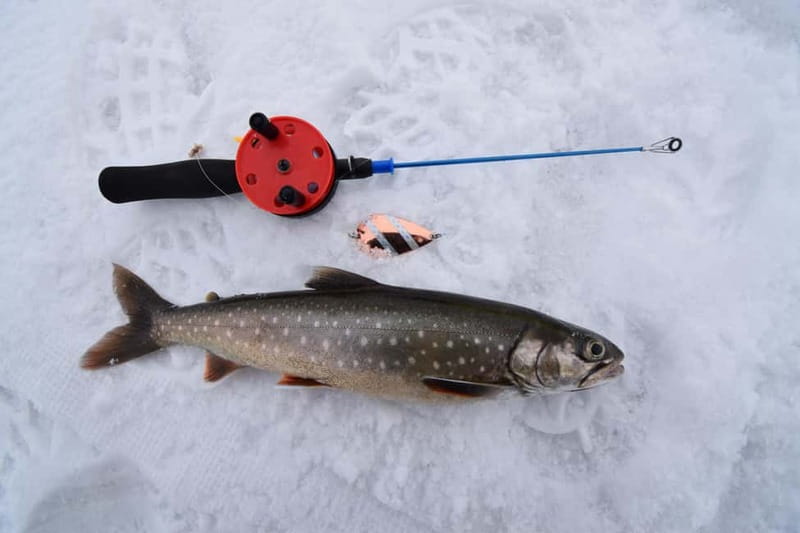
The guide’s role is central because ice fishing has several unfamiliar steps. You learn how to drill the ice, which equipment to use, how to set it up, and how to watch for a bite.
The instruction is practical rather than classroom-like. You get to handle the tools and fish for yourself. A December outing showed how much of the process is included: drilling a hole, waiting patiently, feeling the line pull, and reeling in a fish that eventually escaped.
That kind of near-catch is frustrating, but it also shows why patience matters. The guide cannot make fish bite, but can help you understand what to do when the line moves.
There is no need to arrive with fishing experience. The trip is built as an introduction, so beginners can join without equipment or prior knowledge. The minimum age is seven, and children under seven cannot take part.
The atmosphere: quiet, cold, and surprisingly active
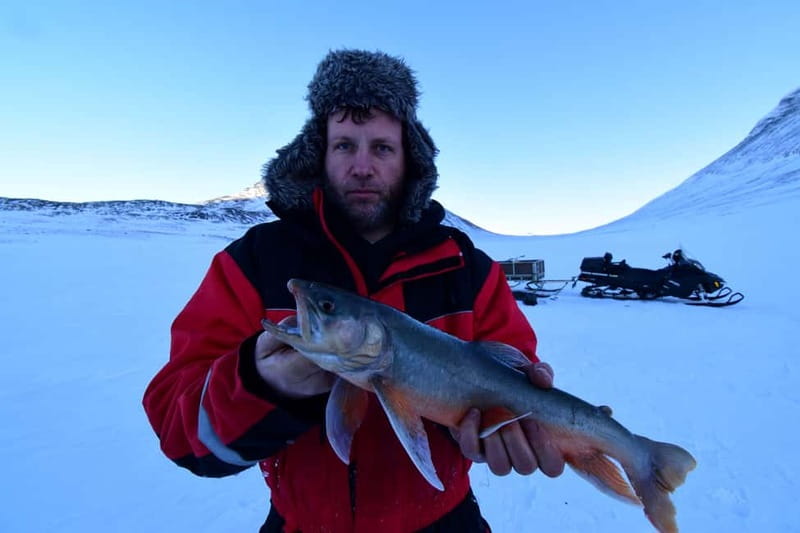
Do not expect constant action. Much of the trip involves watching the line and waiting. For some people, that is the best part. The frozen lake gives you space to slow down, and the clear water gives your attention a focus.
The activity also has a small element of suspense. You may see fish below the hole, feel the line tighten, or bring a fish close before it slips away. Those small moments carry more weight because the pace is calm.
The trip suits people who enjoy trying something unfamiliar without needing a full-day commitment. Two hours is long enough to learn the basics and have a fair chance at a catch. It is short enough to fit around other Abisko activities.
The downside is that the short duration leaves little room for delays. If transport takes longer than expected or you spend extra time learning the setup, your fishing time becomes shorter. One group received extra time after a late start, but you should not count on that every time.
Who should book this experience?
I would recommend it to first-time ice fishers, families with children aged seven and older, couples looking for a quiet outdoor activity, and anyone curious about Arctic life beyond the usual snowmobile ride.
It is also a good choice if you want a guided introduction without buying or carrying equipment. The chance to see fish in clear water makes it more interesting than simply sitting over a hole and waiting.
You may want to skip it if you dislike cold weather, have little patience for waiting, or need a guaranteed catch. The activity takes place outdoors on a frozen lake, and even good fishing conditions cannot promise that a fish will stay on the line.
The two-hour length also suits a first attempt better than a serious fishing trip. If you already spend much of your time fishing, you may prefer a longer or more specialized outing.
Booking, cancellation, and timing details
The experience is offered in English, with live guide instruction. Starting times vary, so you need to check availability for your chosen date.
You can reserve the spot and pay later, which helps if your Abisko plans are still shifting. Free cancellation is available up to 24 hours before the activity for a full refund.
The activity has a rating of 4.8 from 24 bookings, which fits the strongest parts of the experience: the guide-led instruction, the chance to drill the ice yourself, and the unusual possibility of watching fish approach through clear water. That rating should not be read as a promise of a catch. The most important variable is still the fish.
Should you book Abisko ice fishing?
Book this trip if you want a manageable introduction to a distinctly northern pastime. At $99, the package is fair because transport, equipment, bait, warm clothing, drinks, and a snack are included. You only need to arrange your license and bring proper base layers and socks.
My advice is to judge success by the experience, not by the number of fish you take home. You might catch Arctic char, grayling, burbot, whitefish, trout, or perch. You might also watch fish circle the bait and leave.
That uncertainty is part of fishing. If you can accept it, this is a practical, memorable way to spend two hours near Abisko, with enough instruction for a beginner and enough local character to make the cold worthwhile.
FAQ
How long does the ice fishing experience last?
The guided activity lasts two hours. Check availability for the starting time on your chosen date.
What is included in the price?
The $99 price includes transportation, an English-speaking guide, fishing equipment, bait, warm drinks, a light snack, and warm clothing.
Is a fishing license included?
No. You must buy the Kiruna Municipality fishing license separately online through NatureIT or at Godisfabriken Supermarket in Abisko.
Do I need previous fishing experience?
No. The guide teaches you how to drill the ice, choose and use the equipment, and fish through the hole. Fishing gear and bait are provided.
What fish can I catch?
The most common fish are Arctic char, grayling, and burbot. You may also catch whitefish or trout, and perch are possible in some lakes.
What should I bring?
Bring warm clothing, thermal underwear, warm socks, and your fishing license. Thermal underwear and warm socks are not supplied.
Can children join the tour?
Children under seven cannot take part. The activity is suitable for children aged seven and older, subject to the normal outdoor conditions of a frozen lake.
Just landed around the world
- ZANZIBAR FISHING EXPRIENCE★ 3.3 · 6 reviews
- Zanzibar Sea Fishing Boat Tour experience with Transfer★ 3.8 · 16 reviews
- Zante Fishing Tours★ 5.0 · 7 reviews
- Wonga Beach: Hook-A-Barra Fishing Experience★ 4.7 · 16 reviews
- Wonga: Guided Fishing, Farming and Tasting Tour★ 5.0 · 2 reviews
- Ylläs: Snowmobile Adventure with Ice Fishing★ 4.7 · 18 reviews
- From Seoul: Hwacheon Ice Fishing and Lighting Festival Tour★ 4.5 · 4 reviews
- Wismar: Harbor Cruise with Sea Animal Fishing and Guide★ 4.6 · 22 reviews
Sweden Fishing Trips, compared.
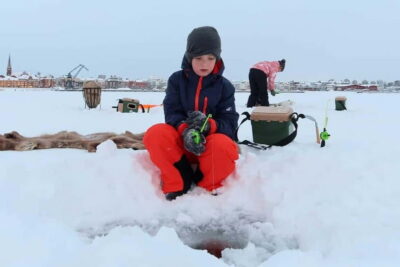
Lulea: Ice Fishing Tour in the heart of the city with Guide
Read our review →Other lists this trip sits in